Pages

Showing posts with label RAF. Show all posts

Wednesday, 1 October 2014

FINAL DAYS OF WAR - AND THE AFTERMATH

After the German capitulation, many Dutch people came out on the streets waving Dutch flags – this could be very dangerous as there were still armed Germans everywhere.  The following morning we went into action; I put on my gear and went into action.  I went into the barracks, a large former children’s home with a big courtyard, and was surprised to see the results.  Some people must have got this place ready, right under the noses of the Germans.  There were at least 200 bunk beds, guns, helmets and ammunition.  There was also a Guard Room, a cycle repair shop, first aid post and kitchen.
Young members of the Binnenlandsche Strijdkrachten. 
Egbert is third to the right of the man with the Sten gun
©Egbert Hughes
Ignoring the Germans, we were set to work immediately.  Our Commanding Officer arranged a meeting with the German Town Mayor where it was decided that they would leave peacefully and we would get on with the various tasks necessary in Post-war Holland.  We were tasked with arresting all the Quislings, male and female collaborators and German sympathisers and the guard duties.  We also did our best to stop the groups of people who were intent on cutting off the hair of Dutch girls who had slept with German soldiers.

Not all Germans surrendered immediately and groups of SS troops were still giving trouble and so the Commanding Officer sent men to guard the road blocks and to prevent any rogue troops from coming back into the town and barricading themselves into buildings, causing more casualties.

ID Card as Dispatcher for the emergency
evacuation of Gouda as the German Army
had flooded large areas to delay the Allies
©Egbert Hughes

I and another fellow were sent to a road near Reeuwijk to stop any Germans trying to get back into town.  We took up positions behind a concrete anti-tank barrier, from where we could see the advancing Allies (probably the Canadians) on the High Road, some distance away.  Suddenly a small German motorised column appeared from under the viaduct and began to advance in our direction.  We fired several warning shots and the Germans replied with a salvo of Spandau machine gun fire which scattered concrete chippings in all directions.

The Allies heard the commotion and rushed to the scene where they dealt with the renegade Germans.  A Canadian Jeep with a Sergeant manning a Bren gun came to a halt beside us; they thanked us and told us to go home.  We reported the incident to our C.O. when we returned to the barracks.
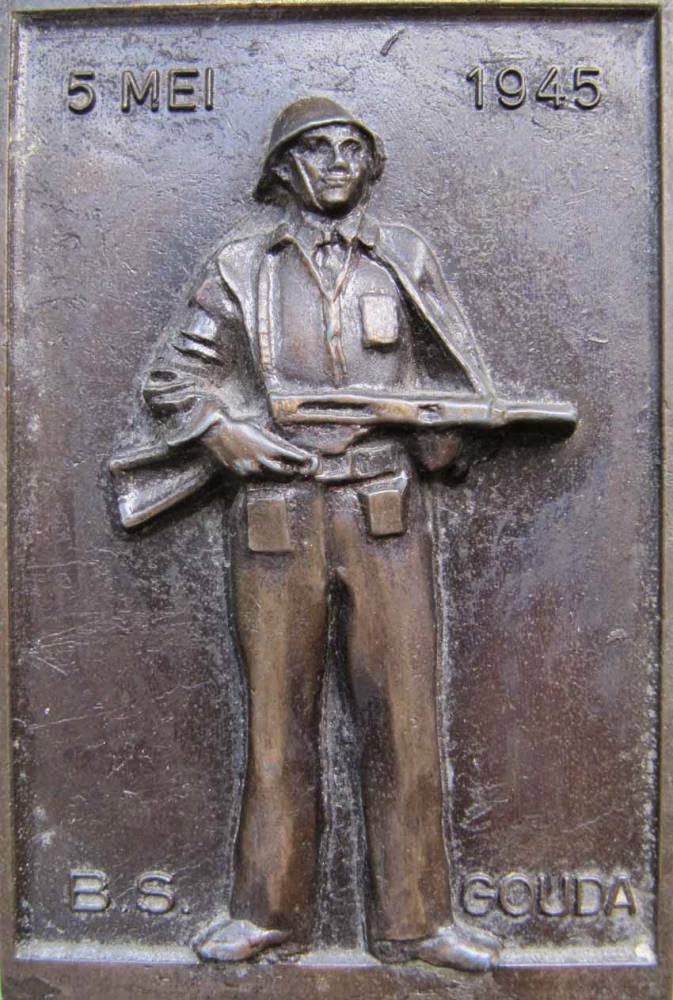
Gouda Interior Forces Bronze Plaque
Origin unknown
One evening, I was detailed guard duties and found that I was to be responsible for a candle lit cellar containing nine German prisoners.  They were probably SS and members of a Deathshead group; they were very dangerous men just waiting for interrogation and I was glad when my shift was over.

On the Sunday morning we went to Scheveningen dunes near The Hague where many officers were meeting and we had to stand outside and guard the marquees.  Although it was May, it was cold and wet and I was shivering.  An Officer handed me a glass of whisky through the tent flaps and said that it would warm me up.

After a few weeks, our duties were coming to an end and after handing in my ID, sten gun and armband, I took on the job of an armed guard for the Canadian garrison.  They gave me a German made machine pistol and the food was excellent!  After they left, I became an assistant with 67 Forward Main Store Section, British Army of the Rhine. Under Captain Larkin, who was also the military town Mayor.

At one of his cocktail parties I met a German Jew named Hugo Kahn and his son Helmut (the rest of the family perished in concentration camps) and they offered me a job in their newly founded instrument factory, mainly making drawing instruments.

After working there for several months, I was called to the office, where I was confronted by a very rude man from the Ministry of Labour.  He told me that I had no right to work in Holland without a work permit.  I lost my temper, I was very angry indeed and he left, saying that he would be back that afternoon.  Indeed, he returned with a female Immigration Officer and they decided that, as an alien, I would be deported.

I was taken to their Head Office, where I was seen by the Head of Department.  He was a very nice elderly official; he looked through my Passport and found the letter from HRH Prince Bernhardt thanking me for my efforts during the war.  He returned my passport and said that my deportation order was officially cancelled.  He wrote a letter and told me to go to Rotterdam and sign on as a ship’s steward.  I did just that but they told me that I could not be considered for the job because I was British not Dutch.

On my way home, at the railway station, I picked up an English newspaper in which I saw that the RAF were looking for engineers.  When I told my mother that I would like to join the Royal Air Force, she was all for it.  She bought me a ferry ticket from the Hook of Holland to Harwich and gave me £5 – which was the maximum permitted at the time.  I packed a wicker suitcase and, on 28th February 1947, I set off for dear old Blighty and endured a very rough crossing to Harwich.

This was the end of an era and the start of a new one.  During my time in Holland two Gouda men died in battle; eighteen Resistance fighters were shot by the Germans; another eighteen did not return from prison and forty five people were killed in bombing raids.  Several hundred Jews perished in concentration camps; sixty people did not return from forced labour camps in Germany; hundreds died of cold and hunger and we were bombed six times between 25th February 1941 and November 1944.  The railway was heavily bombed as it was the main junction for trains from Germany to The Hague and Rotterdam and many nurses were killed when the RAF bombed the hospital.

A NEW ERA IN THE RAF


After arriving at Harwich, I made my way to Euston Station in London and then on to Lime Street Station in Liverpool.  I was hoping to meet my brother John but he was not there so I just had to wait as I did not know where he lived.  Hours later, he appeared and took me to a Chinese restaurant where he ordered a rice dish for us.  I did not know how to use chopsticks so the waiter went to a neighbouring restaurant and borrowed cutlery for me to use!

Afterwards, we went to his digs and he asked about renting a room for me.  The landlord allowed me to stay in an army bed in the attic, rent free, and during the day I stayed in John’s room.

The following day, I went to get my ration books and was given a double ration when I told them where I had come from.  After that I went to the RAF recruiting office and was offered a job as a coppersmith and sheet metal worker.  Shortly afterwards I was sent for a medical, which I passed with ease and, a few days later, I received a travel warrant to take me to No 1 School of Recruit Training at RAF Cardington in Bedfordshire. 

I arrived there on 9th April 1947 and was kitted out, sworn in and we had our group photograph taken.  Following this, my group was posted to RAF Bridgenorth, Shropshire where I was known as AC2 Hughes, Egbert 4023355.  This was where I did my basic military training.

First Group Photo in the RAF (April 1947) - Egbert is second from left in the front row

On the rifle range, we had to fire a Sten gun from the hip and from the shoulder; a sergeant stood beside me and was surprised that I hit the target both times.  He said that the Sten was a difficult and dangerous gun to fire and he almost believed that I had fired one before.  I told him that I had, during the war, but I think he thought I was lying.

Some of the Officers and NCOs were obnoxious to the new recruits and could be cruel at times.  The basic examples ranged from silly to downright nasty; I had to sign a form saying that lack of knowledge of the English language was not an excuse to disobey an order.  On another occasion I was having a smoke beside a grass covered air raid shelter when an Officer and a sergeant approached my group and ordered us to remove our boots and socks.  Those whose nails were too long were made to file their nails down with large files the sergeant handed out.  I always kept my nails short and the Officer instructed the sergeant to give me the bayonet treatment.  This involved sticking a bayonet in the ground and making me hold my finger on the end while the sergeant turned me round and round then made me stand up.  I was dizzy and fell down like a drunk amid loud laughter.

On another occasion, on church parade, the Warrant Officer called for all Roman Catholics and Jews to fall out.  We did not know that the parade was only for Church of England airmen but we waited by the edge of the parade ground.  As I passed the sergeant he whispered “March smart, you bloody Jew!”  I was trembling with anger.

After the parade I went to the Orderly Room and filed my complaint with the Station Adjutant.  He went in to speak to the Wing Commander who called me in and asked why I was so angry and upset.  I explained that some of my family’s Jewish friends had perished in the gas chambers and that was the reason for my anger.  I was dismissed and the sergeant was presumably reprimanded.

More than likely so as he called me out to fall in for lunch one day and when I went out he took me to the armoury where he signed out a Short Magazine Lee Enfield rifle.  He ordered me to raise it above my head and run around the parade square.  In no time, my arms were screaming with pain; however, it came to an abrupt end.  The C.O. must have watched it all from his office window as he came out and shouted me over; he told me to sign the rifle back in and then go for lunch and he would deal with it.  I have no idea what happened but I had no more trouble from that NCO.

After we passed out, I was posted to RAF Keevil near Trowbridge in Wiltshire.  I arrived at Trowbridge Station late at night and there was not a soul about except a Warrant Officer who gave me a lift in his taxi and dropped me at the gates of the airfield gates.  There was only an LAC on duty in the Guard Room and he gave me a cup of tea and told me to sleep in one of the cells.  In the morning I reported to the Orderly Room where I was issued with a bicycle (because my billet was down the road on a farm.  I also received a bayonet to be used on parade.

RAF Keevil, Steeple Ashton nr Trowbridge, Wiltshire
Ironically used as a despatch point for gliders sent on
Operation Market Garden (Arnhem) and on D-Day (France)

I went to the sheet metal shop and met Roy Kirk, the LAC in charge.  He was from Dronfield near Chesterfield in Derbyshire and we got on just fine.  Every month his wife sent him a cake and he always shared it with me.  The Station was due to close and move to RAF Chivenor near Barnstaple in Devon so almost everyone went home on leave, but some of us stayed behind to keep an eye on the place.

One evening I went to the pub in Steeple Ashton and asked for a pint of beer.  The barmaid told me they didn’t have any but offered me a pint of cider, which I accepted and I joined the farm tractor driver.  I finished my pint and ordered another one and he warned me to take it easy as it was powerful stuff.  In Holland, I thought that cider was low alcohol and I thought he was kidding me so I had a third one.  I did feel a bit funny and I said cheerio to him and, as I hit the fresh air outside, I realised I was drunk.  I staggered all the way to my billet, fell on to my bed and went to sleep still wearing my hat and coat.

I woke up staring at the light bulb hanging from the ceiling; I looked at my watch and realised that I had overslept.  I got ready and jumped on my bike and pedalled to the airfield as fast as I could.  The rest of the boys were already lined up outside of the Orderly Room and the Officer said:

“You are late, airman.” 

He asked each of us if we had anything to report and when he got to me he said:

“Airman, there are two red eyeballs staring at me.  Have you been on the Scrumpy last night?”

I said that I had and he told me to go back to my billet and sleep it off and be on guard tonight without fail.

The day came for the move to RAF Chivenor and I went with a civilian driver and a truck load of spares.  But my stay at Chivenor was to be a short one.

I made some good friends there; one was George Ferbrache he was a parachute packer and came from Guernsey.  He always had his pockets full of Horlicks tablets and boiled sweets nicked from the supply of emergency rations in the stores.

27th October 1947 was my 21st Birthday and I received no cards or presents but, whilst I was working on an aircraft, my mate Michael Cartriss, who was from Cardiff, came up and wished me a Happy Birthday from his sister Nancy.  He gave me a card and a Ronson lighter; a nice surprise from a girl I didn’t even know.  However, I went up to Cardiff to meet her and we became firm friends.  George and I often went up to Cardiff for the weekend and stayed with her parents.  They were lovely people but we lost touch after I moved on to another station.

Soon I moved to RAF Weeton near Blackpool and on arrival I was allocated the Wing and Billet that was to be my home for the next eighteen months.  It was winter and freezing and the accommodation had not been used since the end of World War 2.  The boys in there had gone to an empty billet and smashed up some wooden lockers to use as fuel to heat up the place.  The water system was completely frozen up and the workmen were having no luck in putting it right.  Meanwhile we could not have a shower, wash or bath.

The Station Adjutant laid on transport and we went off to the public baths in Blackpool.  It was absolute Heaven to soak in a hot bath.  Over the weeks, things improved and we were able to start our course – with civilian instructors.

I joined the Station sports team and on Wednesdays we had Station sports days and on Saturdays we had cross country.  I took part in the 24 mile News of the World Relay race in Bradford – we each did 4 miles and, after competing we could still go into Blackpool.  For a shilling (5p) we could go to a variety show and then use the same ticket to go dancing in the Tower Ballroom, mostly to Ted Heath and his band.

The Station Entertainment Officer would organise dances and he would invite landladies and their daughters and friends and even lay on transport for them.  I made friends with Mrs Farrant and she gave me a key to her Guest House and said when you are in Blackpool, come and see me and if I’m not at home, help yourself to food and drink.  I was still in touch with her up until about 1970.

As a result of my work, I was taken into hospital with a painful and badly swollen chin.  I had copper poisoning and had to have a lot of penicillin injections.  I felt sorry for the nurses who had to dress that unpleasant area of infection – the doctor remarked that they had caught the infection just in time.

OVERSEAS SERVICE


The time came for an overseas posting and I applied for RAF Eindhoven but when I got to the transit camp at RAF Hednesford near Cannock in Staffordshire, I discovered that I had actually been posted to the 107 MU at RAF Kasfareet in Egypt!

Off we went to Southampton where we boarded the MV Dilwara, built by Barclay Curle & Co Ltd. in Glasgow in 1935.  The crew were all from the Far East and I have never eaten so many curries and ice cream in my life.  We disembarked at Port Said and paraded in an open shed where the WRVS handed out snack boxes.  The Officer called out names and the RAF Station you were posted to.  I failed to catch the name of the station but a sergeant standing next to me said it was OK, he was going to the same station.


We boarded the train and we were on our way and by this time it was pitch dark.  I opened my box and took out an egg and a sandwich as I was hungry.  One of the lads lit his lighter and discovered that the eggs were black inside and must have been steamed.

RAF KASFAREET (SUEZ CANAL ZONE)

We finally arrived at Kasfareet Station; I picked up my kit and opened the door.  I stepped out and fell straight down onto the ground – the train had overshot the platform.  An armed RAF policeman yanked me upright and said I was lucky that a native Egyptian did not get here first or he would have stolen my gear.

We got to the hut and an NCO ordered us to shake the beds down to get rid of the bugs that had a habit of going for your neck and feeding on your blood.  You always knew when it happened because there would be blood on the pillow.  As he went out of the door he reminded us to watch for scorpions, camel spiders and mosquitos.  What the Hell was I doing in this God-forsaken place?


The answer to that soon became obvious as, apart from carrying out our jobs, we had to carry    out guard duties as there was no RAF Regiment to guard the camp and Kasfareet was a very big place.

Sometimes we had to do sleeping in picket; two men had to sleep in the big hangars and that was creepy.  We also had to guard six different areas around the perimeter, standing on the top of a wooden tower swinging a searchlight.  Eventually six of us, including myself, were detailed to carry out ghost patrols.

This involved going to the armoury, blacking my face, drawing a Sten gun and proceeding, after dark, to area six (otherwise called killer corner).  It was littered with old aircraft and crates and the guards on the towers did not know we were there, so I had to be very careful otherwise I could have been shot by my own mates.  The only people who knew you were there were the SPs with their guard dogs.

The boys in the billet used to ask me if I had a bird somewhere as I was not there some nights.  I suppose the other five lads had the same experience.  Lucky I never encountered any local Arabs inside the wire fence.

Other Security jobs included riding shotgun on the school bus; the kids would be very vulnerable if an attack happened.  Nor was I very keen on riding guard on the ammunition lorries travelling between the base and Port Suez Docks – I was supposed to be an engineer, not an armed guard and all for twenty eight shillings (£1.40) a week!

One day, whilst on sleeping picket in the General Engineering hangar, I left my gun locked up in the office and whilst strolling around I saw one of the Egyptian carpenters in the tailor shop making himself a pair of trousers.  I told him to go back to the carpenters shop.  A bit later I saw him again and, once again, I told him to go back to his job.  As I passed him again, two of his mates grabbed me and spread eagled me against a partition.  He had a wood chisel in his hands and was coming for me.

My Sudanese boy, Sam, jumped over the partition and grabbed him by the throat.  The Askaris (Egyptian Police) took him away and probably beat him up.  Sam said to me that I should always carry my gun when I was on my own.  He was probably right.

107 MU BADGE
My main job was inspecting and repairing the fuel tanks on Spitfires as well as lots of catering equipment and motor transport radiators.  I also made lots of toys for the kids in married quarters like rocking horses, model jeeps and motor boats.  The Egyptians used to say that I would be an Officer soon – they obviously thought I was a clever so and so.

One day we went on an exercise in the desert.  A storm broke and the tents went flying as the rain came down.  Lying in damp sand is not very clever and I got bitten on the thighs, probably by sand fleas or beetles.  My legs were swollen to twice their normal size and I was carted off to the camp hospital.  I woke up the following morning and the M.O. was sitting at the end of my bed and said:

“Oh, you’ve made it then!”

But they told me nothing else and it was years later that my brother told me I had suffered a bout of rheumatic fever.

For relaxation I went to Port Fouad which was a sort of holiday camp for service men – all living in tents.  There was nothing much to do but go to the NAAFI and get boozed up.  My brother John and I went there and we went to an open air cinema; it was on a roof top with basket chairs.  I remember just enjoying a beer and watching “3 Coins in a Fountain” when the heavens opened.  Some ran for it, I just stayed put and the rain stopped.  Due to the heat, the steam was rising from my body but I saw the film right through!

I became a member of the 107 MU (Maintenance Unit) Speedway Club; I was no good as a rider so I became the maintenance boy.  I made up the sprocket wheels – they had to have the correct teeth as there was no gear box and I made the steel shoes for the left foot to trail along the ground.  I even converted an old army Matchless into a speedway bike.  We had a clubhouse and bar and raced against teams from Kabrit, Fayed etc.

Egbert's speedway bike, converted from an old Army Matchless
I was also a member of the 107 MU sailing club on the Bitter Lakes.  But all good things come to an end and after eighteen months I had to move on.

This time it was to RAF Khartoum.  I flew in a Vickers Valetta and we were supposed to stop at Wadi Halfa in Sudan but we seem to have missed that!  The pilot said to watch for where the Blue Nile meets the White Nile and then we have arrived.  We were taken to a transit building where we shared the accommodation, Officers and NCOs alike.  It was a mighty hot place.  It was different from Kasfareet in that we were allowed to just get on with the job – no guard duties at all.

A radio chap and I restarted the Khartoum Radio Rediffusion station and supplied piped music to all the billets and Officers’ quarters.  The entertainments Officer gave us 10 shillings (50p) a week and we could buy four 78rpm shellac (breakable!) records per week to add to the collection that was already there.  If I was on duty at night, I would close down at about 10pm, grab a taxi to the NAAFI club then go on to a night club.

I would get back late and just drop my clothes and get into bed.  Up again, dress in shorts and my blacksmith apron and off to work.  When I returned at 1pm, Mack, my bearer, would have washed and ironed my clothes.  He looked after me really well and all for half a crown (12⅟₂p) a week.

Knowing that I liked a challenge, the Wing Commander asked me to maintain all 42 pieces of ground equipment including the two emergency power units.  One was in a stone building in the middle of the airfield.  It was a Lister diesel and it was very hot in there and I had to turn the fly wheel like mad and slam the decompression lever and hope it would start – but it was not always so and I often had a few choice words for it!  The other one was a petrol generator and was in the signals section and much easier to start.

I also had 40 other starter generators etc. and responsibility for United States aircraft in case they developed a fault.  One such job was to repair a big astrodome which had cracked around the rim.  The captain told me not to rush as the crew wanted to take in the sights of Khartoum and do some clubbing.  He always called me a red headed son of a screwdriver.  They always came from Germany en route for Saudi Arabia and always found an excuse for a stopover at Khartoum.

The station fire engines all carried auxiliary engines and it was my job to maintain those too, but the most unusual was the AOC’s yacht!  He had a yacht on the Nile and at one point he had the engine removed and delivered to me in the station workshop for a complete overhaul.  More officially, I had to refurbish the desert rescue vehicle which had been allowed to fall into neglect.  I had to make new water tanks for it and I got the feeling that the RAF were taking advantage of my engineering training in Holland as none of these jobs, other than the water tanks, were my trade – but they knew I liked a challenge.

At one point, my right index finger went septic; the MO lanced it but two days later it got worse and he took me to an army hospital.  They said that they thought he may have cut too deep as I now had a bone infection and they may have to amputate the finger.  When I came round from the operation the surgeon told me that they had saved the finger and my MO was very pleased.

FINAL YEARS OF SERVICE IN ENGLAND


Soon, it was time to return to Blighty and we were told to crate all our equipment, including our khaki drills as we would be flying home from RAF Fayed.  However fate intervened and our places were taken by some wounded soldiers.  We were sent all the way down the Sudan to Eritrea where we handed in our guns to the army and moved on to Asmara in transit to Port Masawa for the arriving troop ship.

One day two of the lads and I went into town and I suggested a drink but they pointed to a sign saying the place was for Officers only.  But we were in civvies so who would know?  We were just enjoying a beer when two MPs came in, swinging their batons.  I told the lads to keep mum and as the MPs came near I shouted:

“Garcon!  Trois bieres,s’il vous plait!”

“Bloody Froggies!” one of them said and went to the next table.

We were taken to Port Masawa to board the troop ship and we boarded under loud cheers from the blokes already on board; presumably they had come from Aden.  Whilst we were under way, it was announced that the King had died.

All went well on the journey until we entered the Suez Canal.  There seemed to be some problem as the doctor would not medically clear the ship and the pilot would not come aboard.  Without him we could not pass through the canal and so some of the ship’s Officers went ashore and must have persuaded them to co-operate.  As we went through the Bitter Lakes it became clear that there was a problem; probably with Egypt, Britain and France as a lot of ships were at anchor in the Lakes, unable to proceed.

We were also refused permission to take on water and so we had to wash in salt water with special soap until we reached Malta.  We docked at Malta under the cheers from local girls who were hanging out of their windows.  We were allowed ashore and I went into Valletta and had a haircut for a shilling (5p).

We had an easy journey and the Irish Sea was as flat as a pancake.  We were destined for Liverpool and disembarkation took a long time due to immigration clearance, railway warrants to be issued and telegrams to be sent to families to tell them when we would arrive.  In my case this was at Euston Station.

My pen pal Olive, and her father were waiting for me;  this was lucky as I would have nowhere to go except the Union Jack Club.  We arrived in West Ealing where Olive’s mum had the Union Jack hanging out of the window.  She was a lovely lady (later to become my Mother-in-Law)   They only had a small flat but they managed to put me up whilst I was on leave.  That went by very quickly as I was posted to RAF Debden near Saffron Walden, Essex.
On leave before last posting to
RAF Debden, Essex, 1952
There were many young Pilot Officers and we were told not to salute them, just Officers carrying higher ranks.  It was quite funny really because many of them came into my workshop and saluted me, probably because of the dust coat I was wearing.

I liked Debden with its tree lined roads and I could, more or less, do what I wanted; nobody interfered with my daily work, I just got on with it.  I liked it even more when I got promoted to corporal; I had a lovely room with parquet flooring and central heating and the buildings were all brick – a far cry from those wooden huts I had been used to.

I had a roomy workshop which I shared with my mate Fred whom I had known from previous postings but we had a little problem when he refused to obey an order and I had to put him on a charge.  He was in the wrong but he wouldn’t speak to me for a long time.  Discipline could be a problem, one day giving the lads rifle drill on the airfield I had trouble with a young conscript.  When I gave the order to fall in and return the rifles to the armoury, he threw it down and said:

“You take it back.”

Discipline was at stake, in front of all the other lads, and I had to put him on a charge.  On the Monday, I was called to see the Group Captain and he asked me to withdraw the charge as the boy’s father was an MP and had requested it.  I refused because my authority would go to rock bottom and so the boy was posted to another station to complete his National Service.

My Wing Commander was a super guy and as long as I carried out all my jobs, he would just let me get on with things.  One day I had a request from the boss to make a wrought iron fire tidy for the Officers’ Mess.  All I had to do was buy a little brush.  I bought several and, having made one, I got orders from other Officers so I made a bit of money on the side.

I also collected the empty 5 gallon oil drums, cut off the ends, flattened and stored them until the young Officers with old cars needed a silencer repairing or a running board strengthening.  More beer money for the NAAFI!  I also did a good trade in mottled copper kettles, brass coal scuttles, sailing boat table lamps, wishing wells and turned wooden fruit bowls – all very profitable and enjoyable.

On a more official level, the Wing Commander would come in and say that he had a job that even I couldn’t do (he knew I liked a challenge).  We had a luxury fitted ambulance to be used only in case the Duke of Edinburgh crashed during his flying lessons.  However, a motor transport driver used it to take an urgent case to Ely Hospital but he drove under a low bridge and smashed in the whole roof including the ventilators.

There were no drawings to make the air ventilators, so he arranged for Fred and I to be flown to RAF Benson, in Oxfordshire, to make drawings of their ambulance.  I had to cut away the whole of the roof and make a new one.  I had to fit the air ventilators and rivet the whole thing back in place; not an easy job, I must admit, and every day the Wing Commander would ask me how it was going

Between the roof and the inner lining was a lot of glass wool (very itchy stuff to work with) and then there was a load of sealant and red oxide paint to apply.  I sprayed the roof Air Force blue and painted on the Red Cross logo – job done!  An A.I.S. inspector came to pass the job and he was mildly surprised to find it as good as new.  I was quite chuffed and the Wing Commander was very happy.

Of course there were very serious jobs to be done.  One weekend in 1953, when I stayed in camp, I was awoken by the sirens going hell for leather at 5am and the loudspeakers ordered us to parade on the Camp square.  I thought it was World War 3 but we were ordered to kit up with rubber boots, warm clothing and spades.

We were taken to the Essex coast and, to our horror, we saw enormous breaks in the sea defences.  We saw dead cattle floating in the flooded meadows and we were ordered to fill those breaks in the sea wall.  It was a very big job but there were thousands of Army, Navy and Air Force personnel to deal with this task.  This was known as Operation King Canute

Civilians and Military rebuilding sea defences, Essex 1953
The weather was terrible and very cold; the first day we only had half a cup of tea and half a sandwich and we spent the night on the concrete floor of the village hall at Southminster.  The next day a naval Officer came in with a boat and handed out rum, which was more than welcome.
More rebuilding work on the sea wall, Essex 1953
In Holland the floods were very bad and several thousand people lost their lives.  I was very glad to return to Debden after two weeks of very hard work and soak in a hot bath.  After that I did two more weeks on the coastal defences.

Some of the worst things we had to deal with were the air crashes.  A Canberra nose dived into the ground on a playing field in Bishops Stortford.  Coming down at very high speed, it had just disintegrated and buried itself into the ground.  We had to camp out on a very cold night to guard the scene and, in the morning, we had the traumatic job of digging to find any human remains.  We did manage to find some remains of these poor devils.  The crew were P/O John Leonard Hoyle (pilot) and F/O Michael Harry Webber (navigator).  The aircraft had taken off from RAF Bassingbourn in Cambridgeshire on 11th January 1954 and had trouble starting one of the engines but the cause of the crash was unknown.

Just over a year earlier, we had been preparing for a Battle of Britain open day when two of our Avro Ansons collided.  The pilots, F/Lt Jarvis and F/Lt Sheriff, were both killed but the show had to go on. We had Lincolns doing bombing runs and ground crews blowing up explosives to entertain the crowd which included my pen pal and her parents.

In 1955, I was interviewed by a career officer who offered me another four years as I was about to be promoted to sergeant.  However, I decided to leave the RAF and take up a civilian job.  I went to RAF Kenley to sign on for my four years on the reserve and to collect my demob suit and left the RAF in May 1955.  Because of my qualifications and experience I had a job with British European Airways (now part of British Airways) even though I had no home to go to.
The Wing Commander's Final Reference


Another tribute for services rendered

Friday, 26 September 2014

OUTBREAK OF HOSTILITIES

Egbert “Dutchie” Hughes – A Life at War

The following story is as told to me by Egbert “Dutchie” Hughes and represents his personal memories, as told to me, from birth to the end of the War:

On the morning of 10th May 1940, I was awoken by the drone of heavy bombers and the rattle of machine gun fire.  This could only be dog-fighting between the modern German fighters and the antiquated Royal Dutch Air Force in their ancient bi-planes.  I later learned that 65 of the 140 strong Dutch Air Force planes had been destroyed on this first day of fighting.

looked out of the window and noticed a lot of Dutch military activity; I got dressed and went down to speak to the soldiers and ask them what was happening.  Thewasy told me that Germany had invaded The Netherlands and that heavy fighting was going on in some areas.  German paratroops had landed in all the strategic areas such as the Ports, airfields and even the grounds of the Royal Palace in The Hague.  However, the Royal Family had already fled to England, via Zeeland, and would establish a Government in Exile there.

Reporting the news to the British People
The London Evening Standard - 10th May 1940
 
After five days of heavy fighting, the Dutch Military authorities decided to surrender because of the heavy loss of life that had already taken place and to prevent any further unnecessary bloodshed.  On 15th May 1940, General Henri Winkelman signed the Dutch Capitulation documents.  However, this was not before the Luftwaffe received the order to stop bombing and Rotterdam received a serious pounding and many civilians and Dutch and German troops were killed in the fighting.

During the fighting, the sky was filled with smoke and the smell of burning paper; the sky was full of bits of burning paper.  Thousands of people fled from the battle areas, mainly on bicycles, and escapees from the burning city of Rotterdam gravitated towards Gouda.  My mother took in 19 refugees; the ladies slept in our beds and the remainder – including us – slept on the floor.

The next morning, a Dutch Army vehicle stopped outside our door.  I went to see and it was laden with soldiers, all in a state of shock, one of them was crying and shaking like a leaf.  I got a glass of water and held it to his lips, but he was shaking so much, he spilled most of it and his teeth were rattling against the glass – I don’t know what happened to them.

A few days later, I was standing on the pavement and heard the sound of a heavy vehicle; I heard a German tank come round the corner, with many marching soldiers singing their marching songs.  I took an instant dislike to their jackboots and their awful helmets.  They came to a halt and started knocking on doors asking for their water bottles to be filled.  I think they had been told to be friendly towards the Dutch people, because they were not hostile.

They went on and assembled in the Market Place; some of them started to take over buildings such as schools and warehouses, and the Officer in charge settled himself in the Hotel de Zalm in the Market Square.  The Germans wasted no time in exerting their authority – posters and signposts appeared everywhere, telling us that the penalty for disobeying German orders would be death.

At some point, after the invasion, I returned to school, but one day a German teacher arrived – probably to promulgate some German propaganda – and I made my resentment noticeable.  I decided to leave school and took a day course in engineering at the Technical College; later, I changed to evening classes but this soon became impossible because of the curfew imposed by the Germans.

Image © London Evening Standard 

Thursday, 25 September 2014

INTERESTING PEOPLE

Egbert Hughes - Gouda, Holland - May 2014

During the course of my blogging about WW2 I have come across many people whose own stories are every bit as fascinating as the people I write about but don't qualify to be included in my blog because they were never members of 304 Squadron.  This was a Polish Squadron that caught my attention because one of their bombers crashed close to the house where I was born.
My first subject married the widow of one of the Polish pilots I wrote about and he gave me so much help, documentation and advice about one of my own characters, that his story got pushed to one side but simmered on the back burner until I began to realise just what a fascinating story it was.
There have been others like him and they will make up the entire contents of this blog, which I hope will slowly build up to be as successful as my other one.  Meanwhile, the story of Egbert Hughes will build up here.
At 87 years old (soon to be 88) he looks like everyone's favourite uncle.  But he has had a lifetime of experience that most of us will never know.  It would be a shame not to tell his story.